October always brings bittersweet feelings of sadness, but also relief. At this point, I am tired. I am exhausted from the planting, harvesting, weeding, pest management, and overall crisis management of a growing farm. So naturally, I am relieved to button up the rows. Clearing away the season's growth, preparing the soil for a shallow till, and laying down a blanket of weed fabric for their winter rest.
I keep my head down and work each row according to its individual needs, paying respect to everything it gave me that year. In doing so, I begin to feel the sadness that another growing season has already come and gone. 2026 has given me all the flowers she was going to give me. I occasionally look up from my work, somewhere between somber and grateful.
There was a moment this season when I didn't think I would have what I ended up gaining and growing. Early in the season, June 10th to be specific, because that date is burned into my head, was a day I thought I had lost it all.
An intense hailstorm swept through our little slice of earth and decimated everything I had planted that week, much of which I had planted that very morning. This storm wasn't abnormal for that time of year or even our specific area. But this particular one was not only devastating in its intensity, but magnificently disappointing in its timing.
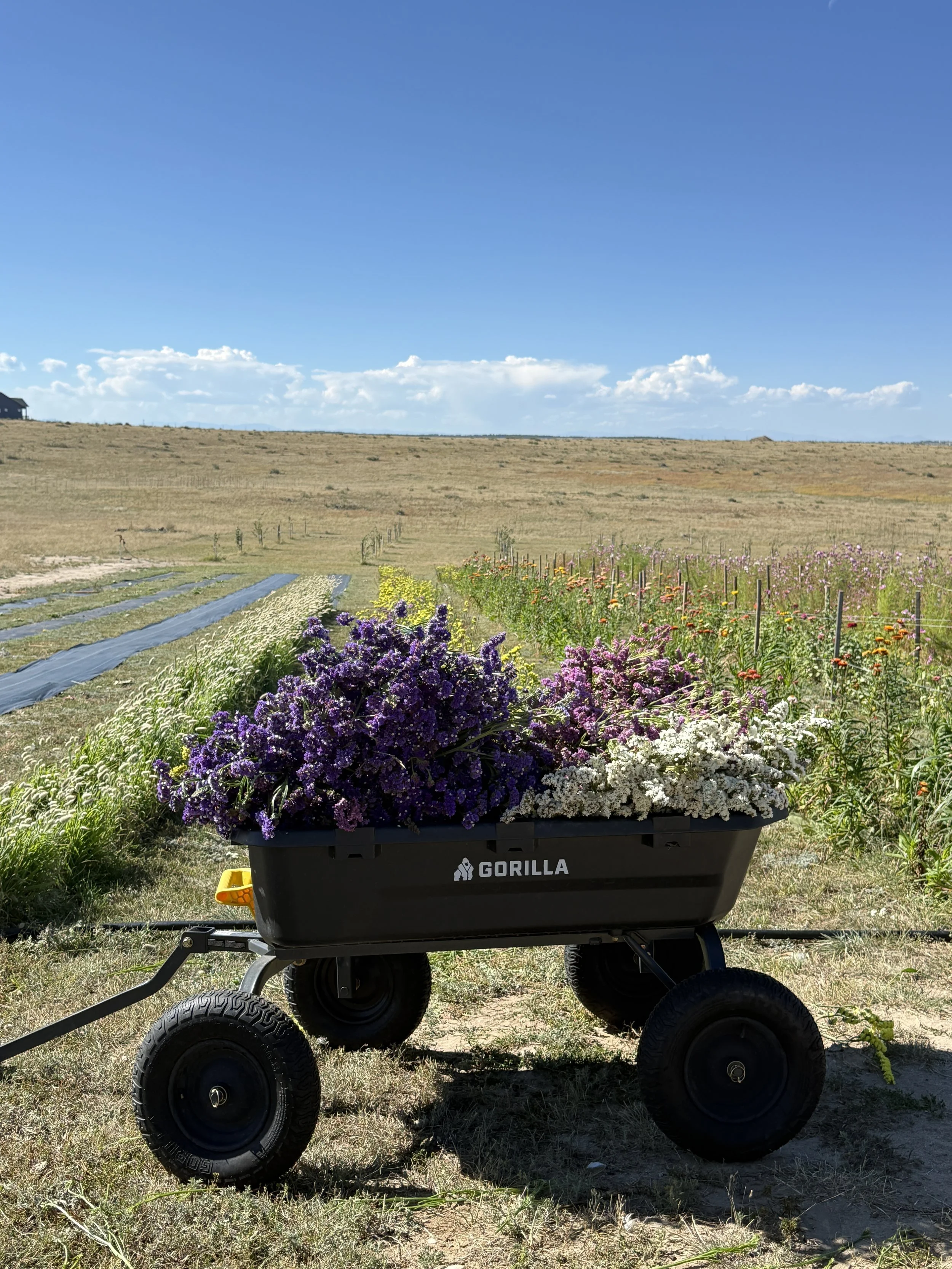
Our harvest of statice in a wagon, but you can see the sitting empty rows behind them ready to be filled next year!
My newly planted seedlings stood no chance. Hundreds of hours of labor, months of growing progress, and many, MANY dollars were lost in a matter of minutes.
Talk about a disappointment.
But there was more to it than that. It was a sobering realization of how little control I truly have over the weather, how dependent I am on God's provision, and how easily I can become attached to the worldly things I work so hard to attain. It was humiliating, humbling, and so, so hurtful.
The Cost of Lost Time
What disappointed me most in those initial moments wasn't necessarily the loss of the plants themselves. It was the loss of everything that went into growing them.
Every seedling lying battered in those rows represented weeks, sometimes months, of work. The planning, the seed starting, the watering, the tending, the hardening off, and finally, the labor of getting them into the ground.
And almost immediately, my mind began calculating what it would take to replace them.
How many more seeds would I need to start? How many weeks would it take before those seedlings were ready to transplant? How much of my growing season would be left by the time they made it into the ground?
As a gardener in Colorado, I knew the answers to those questions weren't particularly promising.
I could replace the seeds. I could replace the seedlings. But I couldn't replace the time.
I think, deep down, I already knew that some of those beds would never become what I had intended them to be that year. And yet, I wasn't quite ready to accept that.
However, as I look out over my fields in the crisp October air, I have a fresh perspective on that moment. Looking back, it feels as though God gave me triple for my grief.
I found myself reflecting on the story of Job throughout that season. Although my circumstances hardly compare to the magnitude of his suffering, his story challenged me to examine my own heart. Had I become more attached to the fruit of my labor than to the One I professed to worship? Would I still praise Him if I couldn't see a harvest in my future?
I don't pretend to know why God allowed that storm, but I know what it revealed in me.
Where I initially saw only devastation and disappointment, I found myself turning to Him. I got back on my knees and went back to work, learning to worship through the labor of growing this garden on the inside as well as the outside.
But I don't want to make this a blog about the good and faithful servant I am trying to be. To be honest, I am imperfect. I am a sinner who can respond to disappointment in ugly and petty ways, just like most people.
That's the rawness I want to dive into here. Disappointment is a nasty beast, and I think it's an emotion we all need to acknowledge, dissect, and examine within ourselves.
Let me preface this by saying how grateful I am for everything I grew this year. It ended up being our best growing season yet. We nearly tripled our growing space, so despite a massive loss, we also experienced incredible growth. I grew in my business, too. Offering experiences with my community grew both me and Shari's more than any previous year.
So while I am talking about disappointment in this blog, I am far from ungrateful.
But what do we do when we feel disappointed? And I am not just talking about gardening our soil, but about what we are cultivating in our lives and within our souls.
When Trying Again Still Isn't Enough
In the weeks following the hailstorm, I was determined to recover as much of my growing season as possible.
I began by direct-sowing seeds into some of the empty rows, hoping to eliminate the weeks it would take to start them indoors. Those seeds were eaten almost immediately.
I started more seedlings, but by the time they were ready to go into the ground, the Colorado summer was well underway. The days were hot, the soil dried quickly, and the conditions were considerably different from those I had planted in earlier that spring.
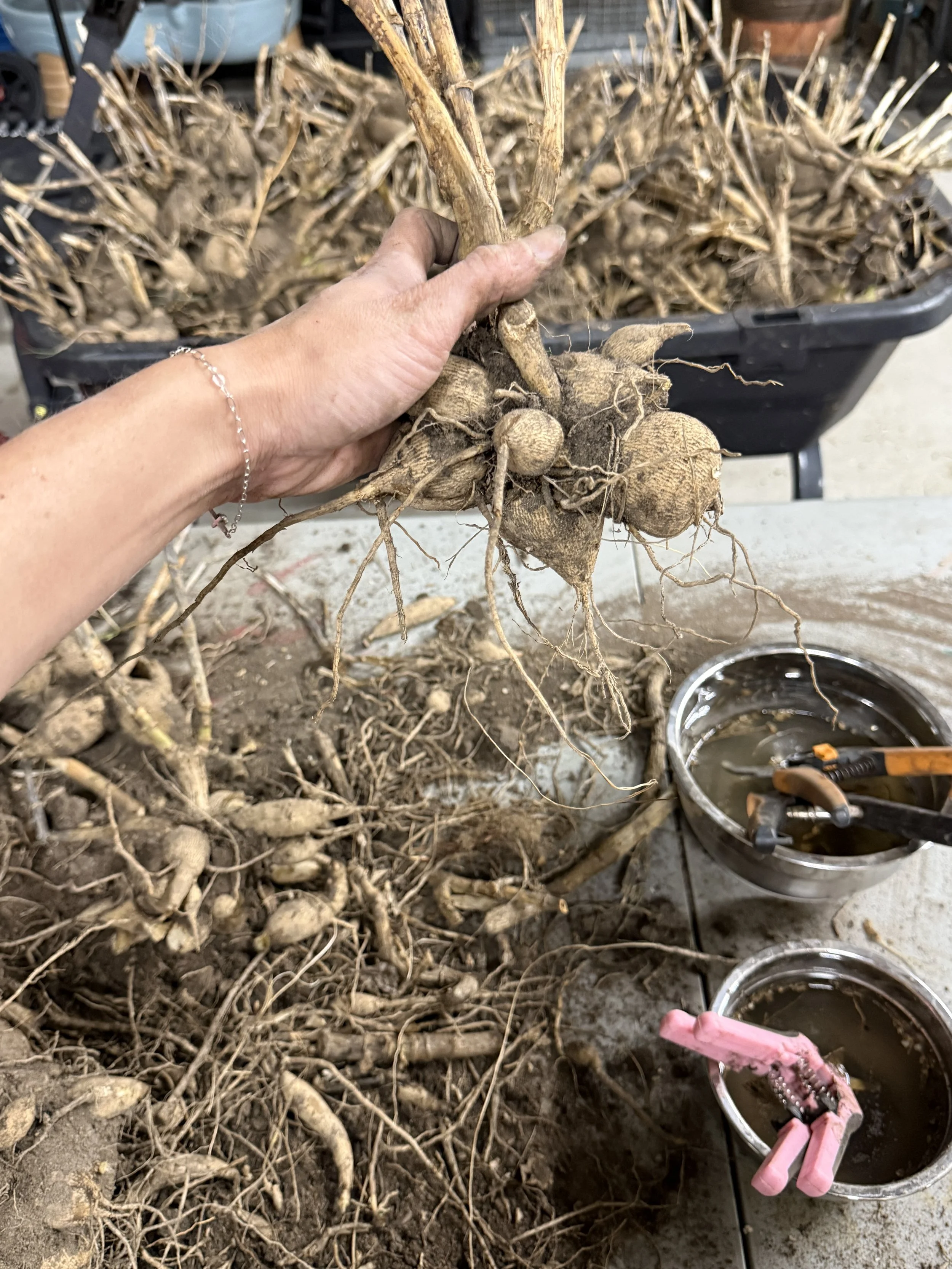
October is also Dahlia digging month too. What a privileged it is to be able to store these all winter.
In my eagerness to get everything back into the ground, I admittedly rushed some of the hardening-off process. Within a week, many of those little seedlings had dried up or simply disappeared altogether.
Even among the plants that survived, some never reached a harvestable height. Others grew throughout the remainder of the summer but never produced a single flower before our first frost.
More disappointment.
And this time, it wasn't necessarily the result of some catastrophic event that was entirely outside of my control. Some of it may have been the result of my own rush to recover what I had lost.
As a gardener, I understood the importance of timing, temperature, and growing conditions. I knew that putting a seed into the ground didn't guarantee its success. I knew that a seedling needed more than just my willingness to plant it.
But as someone who had poured months of work into those fields, I wasn't quite ready to accept the loss.
I think there is something worth examining in the way we respond to disappointment. Sometimes our immediate response is to work harder, invest more, and try again. We convince ourselves that if we can just give a little more of our time or energy, perhaps we can still achieve the outcome we originally envisioned.
And sometimes, that determination serves us well. Perseverance is an important part of gardening, just as it is an important part of life. But perseverance also requires discernment. We have to be willing to evaluate the conditions before us rather than make decisions based solely on what we wish those conditions were.
Looking back, I wonder how much of my determination to replant came from a genuine opportunity to recover the season, and how much came from my stubborn unwillingness to accept that part of it had already been lost.
Because sometimes, the hardest part of experiencing disappointment isn't deciding whether to try again. It's recognizing when our efforts alone can no longer change the outcome. And that is a lesson I am learning far beyond the boundaries of my flower fields.
I've realized that I've approached certain areas of my life much the same way. There are relationships I've invested in, circumstances I've hoped would change, and versions of the future I've quietly held onto, even when the conditions suggested otherwise.
As a mother, I've been particularly intentional about cultivating a sense of family and belonging for my children. But part of that journey has been recognizing that not everything I envision is mine to create. Some relationships require a willingness on both sides, and some circumstances require us to make decisions we never hoped we would have to make.
There is disappointment in that realization. Not necessarily anger, but a quiet sadness for what could have been. I can wish others well while making thoughtful decisions about what I cultivate within my own home. And I can acknowledge that some things may find their season later, while others may never grow into what I imagined.
Perhaps you've experienced something similar. A relationship, an opportunity, a career, or a chapter of life that you've invested considerable time and hope into, only to find yourself standing somewhere entirely different from where you thought you would be.
How much of our disappointment comes from what actually happened, and how much comes from having to let go of what we imagined would happen?
And how often do we continue investing in that imagined future simply because accepting its absence feels like another loss?
There is no denying that the hailstorm this year was an absolute disappointment. It was obvious, in your face, and a blow to the gut that knocks the wind right out of you.
But what about the disappointment that isn't as obvious?
What about the small, continuous disappointments that accumulate over time, each one making another deposit into a growing bank balance of emotions? Or the subtle disappointments that we don't even feel like we're allowed to experience?
Perhaps we dismiss them because we have so much else to be grateful for. Perhaps we feel guilty for wanting more from a particular relationship or circumstance. Or perhaps we've grown so accustomed to being disappointed that we've stopped acknowledging it altogether.
I wonder how many of us are carrying disappointments we have never properly grieved. And I wonder how much those disappointments are influencing the way we approach our relationships, our expectations, and even our relationship with God.
What do we do when things don't go as planned, when things are taken away, or when people let us down?
What does God actually say about the disappointment we carry? And how does He call us to respond to it?
When Hope Is Deferred
“Hope deferred makes the heart sick, but a longing fulfilled is a tree of life.” — Proverbs 13:12 (NIV)
I find it comforting that Scripture acknowledges the very real effect that disappointment can have on our hearts. There is no instruction here to simply be more grateful, to stop feeling sorry for ourselves, or to find the silver lining in every unfortunate circumstance. Instead, there is an acknowledgment of something very human: when we spend a considerable amount of time hoping for something that continues to go unfulfilled, it can make our hearts sick.
What does disappointment look like when it has been sitting in our hearts for months, years, or even decades? Does it still present itself as sadness, or has it developed into something else? Resentment? Bitterness? Grief? An unhealthy dependence on ourselves? Perhaps even an unwillingness to hope for anything at all?
I honestly think sometimes we become so familiar with our disappointments that we fail to recognize how much of our personality, our behavior, and our decision-making has been shaped by them.
We stop asking for help because we have been disappointed by those we once relied on. We stop extending invitations because we have been disappointed by those who never showed up, called, or inquired on their own. We lower our expectations, not necessarily out of humility or contentment, but as a means of protecting ourselves from experiencing that same disappointment again.
And while those responses may be understandable, I think we owe it to ourselves, and more importantly to God, to examine what is happening within our hearts.
Proverbs 13:12 is an observation of the human experience, not a promise that every longing we have will eventually be fulfilled. That is a difficult distinction to accept. I would love to believe that everything I have patiently hoped for will eventually come to fruition. But Scripture does not promise me that.
So, if I cannot guarantee the fulfillment of my hopes, what responsibility do I have in the disappointment that follows?
What Is Mine to Carry?
“If it is possible, as far as it depends on you, live at peace with everyone.” — Romans 12:18 (NIV)
I have spent quite a bit of time reflecting on those two qualifications: if it is possible and as far as it depends on you.
In Romans 12, Paul is instructing believers on what it looks like to live a life transformed by God. He speaks of sincere love, patience in affliction, faithfulness in prayer, humility, and refusing to repay evil for evil. His instruction to live at peace with others is part of a much larger conversation about our conduct as followers of Christ.
What strikes me about this particular verse is that while we are given a responsibility, we are also reminded of its limitations.
I am responsible for the sincerity of my love, the words that come out of my mouth, the intentions behind my actions, and the way I respond when someone disappoints me. I am responsible for acknowledging my own shortcomings, seeking forgiveness when I have caused hurt, and examining whether the expectations I have placed on others are fair. But I am not responsible for another person's willingness to participate in a relationship. I cannot manufacture a desire in someone else, nor can I make decisions on their behalf. And I think there is a considerable amount of exhaustion that comes from confusing those two responsibilities.
Much like my efforts to recover my flower fields, I have to ask myself whether I am being faithfully persistent or whether I am stubbornly attempting to control an outcome that is not entirely mine to determine.
That doesn't mean I am excused from loving difficult people. It doesn't mean I am entitled to harbor resentment because someone has disappointed me. Nor does it mean that every relationship that requires effort should be abandoned.
But pursuing peace does not require me to ignore harmful behavior, compromise the well-being of my family, or pretend that a relationship is something it isn't.
There is also a less comfortable side to examining our disappointments. Sometimes we need to consider whether the source of our disappointment is an expectation we have created ourselves. Have we communicated what we need? Have we given others the opportunity to understand us? Are we expecting someone to fulfill a longing they never promised to fulfill?
And sometimes, after honestly examining those questions, we may still find that our disappointment is entirely reasonable. We may have done everything within our ability to cultivate something good, and it simply did not grow.
Our responsibility as Christians is not to guarantee the outcome. It is to remain obedient to God in the way we conduct ourselves, regardless of the outcome.
Bringing Our Disappointment to God
Perhaps the most comforting discovery in studying disappointment through Scripture has been realizing how openly people expressed their disappointment before God.
Psalm 13 begins with David asking:
“How long, LORD? Will you forget me forever? How long will you hide your face from me?”
David continues by expressing the sorrow within his heart, asking how long he must wrestle with his thoughts and carry that sorrow day after day.
There is something remarkably vulnerable about this passage. David is not carefully arranging his emotions into something that sounds particularly faithful. He is expressing the anguish of feeling forgotten by the very God he trusts.
And yet, he is expressing that anguish directly to God.
I wonder how often we deprive ourselves of that kind of conversation with Him because we believe our disappointment is somehow evidence of our lack of faith. How often do we feel the need to preface our prayers with everything we are grateful for before we allow ourselves to admit that something hurts?
Gratitude is an important part of our relationship with God, but it does not require us to conceal our sorrow.
What I find particularly beautiful about Psalm 13 is the progression of David's prayer. He begins by expressing his distress. He then asks God to look upon him and answer him. And finally, he declares his trust in God's unfailing love.
What we are not told is whether anything about David's circumstances changed during that prayer.
There is no account of his troubles suddenly disappearing, no explanation of why he had to endure them, and no indication that every question he asked had been answered.
And yet, he ends his prayer in trust.
I think that is where I am finding myself in this season of my life. There are disappointments I can look back on and see how God has provided through them. The hailstorm is one of those experiences. I can stand in my fields today and recognize the abundance that came despite what was lost.
But there are other disappointments for which I have no such resolution. There are things I may never fully understand, relationships that may never become what I hoped they would, and longings that may remain unfulfilled.
Can I trust God in those circumstances, too?
Can I bring Him the disappointment without expecting Him to resolve it in the way I have envisioned? Can I ask Him to examine my heart, correct my thinking where it needs correcting, and help me grieve what genuinely deserves to be grieved?
I don't want my faith to be dependent upon whether or not I see the flowers bloom.
I want to be able to come before God with the same honesty David demonstrated in Psalm 13. To tell Him what hurts, to ask Him for help, and to trust in His character even when I cannot make sense of my circumstances.
Perhaps that is where we begin with our disappointment. Not by immediately trying to fix it, justify it, or find something beautiful within it, but by acknowledging it honestly, examining our responsibility in it, and bringing it before the Lord.
We do not have to wait until our hearts are free of disappointment to approach God. We can bring Him the very hearts that disappointment has made sick.
What We Do After a Failed Harvest.
What has truly interested me is the comparison of external crop failures in my garden, and my personal disappointments in life. They often need to be addressed in the same way. Again, the garden gives us guidance on how to tend our lives with more perspective and intention. Here is what I have connected:
1. Assess the damage before reacting
In the garden: Following a hailstorm, it is tempting to immediately pull everything out and start over. However, damaged foliage doesn't necessarily mean a plant is dead. Depending on the crop, healthy roots, intact growing points, and surviving nodes may allow it to recover. Assess each crop individually before making decisions driven by the initial shock of the damage.
In our lives: When we experience disappointment, we can be quick to make sweeping conclusions about our lives based on one painful experience.
One failed relationship becomes people always disappoint me.
One failed opportunity becomes I am not good enough.
One unanswered prayer becomes God isn't listening.
We need to separate what actually happened from the conclusions we have drawn because of it.
2. Investigate the cause without assigning unnecessary blame
In the garden: When seeds fail to germinate or seedlings fail to thrive, a good gardener investigates. Was the soil too cold? Were the seeds planted too deeply? Was there inadequate moisture? Pest pressure? Poor hardening off? Or was there an environmental event that could not reasonably have been prevented?
Understanding the cause helps us make informed decisions moving forward. It isn't about punishing ourselves for a failed crop.
In our lives: We need to be willing to examine our disappointments with that same curiosity and humility.
Was our expectation realistic? Did we communicate our needs? Were there circumstances outside our control? Did we overlook something because we were so invested in a particular outcome? Did someone genuinely fail to uphold a commitment?
Sometimes we will discover something we need to change within ourselves. Other times, we will discover that we were not responsible for what happened.
Self-examination should lead us toward wisdom and, where necessary, repentance. It should not become an exercise in self-condemnation or shame.
3. Evaluate the season you are actually in
In the garden: Before replanting a failed crop, consider the remaining growing season. Look at the anticipated first frost, days to maturity, germination requirements, temperatures, and the time needed for seedlings to establish.
A crop that would have been perfectly reasonable to plant in May might no longer be practical to plant in July. That doesn't mean it was a bad crop or that you are a bad gardener. The conditions have changed.
In our lives: Sometimes we continue pursuing something because it once made sense for us, without considering whether it still makes sense in our present circumstances.
Our responsibilities change. Our capacity changes. Relationships change. Our understanding of what is healthy and sustainable changes.
Consider whether you are making decisions based on the circumstances you are actually living in or the circumstances you wish you were living in.
This doesn't mean abandoning something simply because it is difficult. It means exercising discernment about where and how you continue investing your time, energy, and resources.
4. Change your approach before trying again
In the garden: If your first planting failed, repeating the exact same process without investigating or adjusting the conditions may produce the same result.
Perhaps you need to harden off your seedlings more gradually, provide temporary shade, improve your irrigation, protect seeds from pests, or choose a faster-maturing variety.
Sometimes the wisest decision is not to replant at all, but to protect the soil and prepare the bed for next spring.
In our lives: Perseverance does not always mean repeating the same efforts.
Sometimes moving forward requires an honest conversation, an apology, asking for help, establishing healthier boundaries, changing an expectation, or allowing ourselves time to grieve.
Before you invest more of yourself into something that has repeatedly disappointed you, consider what meaningful changes would need to take place. Which of those changes are within your responsibility? Which require the participation of someone else?
This is where we can practically apply Romans 12:18.
5. Don't neglect what is still growing
In the garden: One of the dangers of experiencing a crop failure is becoming so preoccupied with recovering what was lost that you neglect the crops that survived.
Those plants still need watering, harvesting, weeding, fertilizing where appropriate, and pest management. Spending all your time trying to recover a failed row could ultimately compromise the health of the rest of your garden.
In our lives: This might be one of the most important lessons disappointment can teach us.
How much of our emotional energy is being spent on what we wish we had, at the expense of what we already have?
Are we so consumed by the relationships that disappoint us that we overlook the people who consistently show up? Are we so focused on an opportunity we missed that we fail to recognize the opportunities in front of us? Are we so occupied with the life we imagined that we are struggling to be present in the life we are actually living?
This is not an invitation to minimize our grief. It is an invitation to be good stewards of what remains, even while we grieve.
We can mourn the flowers that never bloomed while continuing to tend to the ones that did.
6. Prepare for another season without demanding a harvest
In the garden: At the end of a disappointing growing season, there is still meaningful work to be done.
We can document what worked and what didn't, evaluate our planting schedules, improve our soil, maintain our equipment, and make better-informed decisions for next year.
We can learn from a failed crop without allowing it to convince us that gardening is no longer worth pursuing.
In our lives: Disappointment can make us reluctant to hope again. We may begin to believe that expecting nothing is the safest way to live.
But protecting ourselves from every possible disappointment can also prevent us from experiencing meaningful relationships, opportunities, generosity, and joy.
We don't necessarily have to hope for the exact same thing again. We don't have to return to harmful circumstances or reopen doors that were wisely closed.
But we can remain open to the good that God may bring into our lives without insisting that it arrive in a particular form.
Final Note:

I don't typically write during the growing season. It's a grace I've given myself so that when I do sit down to explore concepts like this, I can give them my all. It's an effort to spare myself the disappointment of not being able to give something, or someone, my full attention during the grueling growing season.
Perhaps it's for the best. It allows me to write with a bird's-eye view of my season, with the whole story in mind rather than from the emotions of a single moment. Maybe that is what excites me most about this time of year.
Although I am sharing this in November, I've been working through this study since early October. Much of it took shape in my head during those brisk afternoons, head down, working my fields. In those quiet moments, I've experienced feelings of sadness, disappointment, but above all, a gratitude you could never imagine.
I am learning that I can grieve the flowers that never bloomed without regretting that I planted them. I can acknowledge the empty rows without overlooking the abundance that surrounded them. And I can trust God with the things I cannot cultivate, repair, or understand, without neglecting what He has entrusted to my care.
My prayer for you is that your disappointments do not harden your heart. That God gives you the wisdom to discern where to continue investing your efforts, the courage to surrender what is beyond your control, and the faith to trust Him even when the harvest looks nothing like you imagined.
I hope you see yourself in these thoughts. I hope these ideas that crawl into my head in the quiet of my work can resonate with whatever is disappointing you in your own life.
I would love nothing more than to offer a soil perspective into your soul.
Until the next lesson,
Jessica
Shari Ann Farms