Why am I so Tired?
Every year around this time I am approaching burn out. Not because I am unhappy, but because I am tired. The good kind of tired, the tired that you feel after a workout that burns a bit, but feels productive and for purpose. Every year around this time, I am itching for frostmas (first frost) and it’s time to really dive into why I feel this every year.
Because this year was different…. Frostmas hasn't really even come yet. Colorado is hitting record breaking temps and a record breaking absence of snow or even precipitation, for this time of year. I know we are a dry state, but COME ON, absolutely no snow or even freezing rain yet? This year I had replanted over 900 lavender plants and we just put in 60 apple trees in September. They need more water than anything else on the farm. I am begging for dormancy, while also trying to be thankful for the extra opportunity that will allow them to establish their foundation for an inevitable harsh Colorado winter. So this year, I am extra tired. It’s like this season has gone into overtime thrice over, and I am realizing how truly desperate for rest I am, this time, every year.
Why am I yearning for rest so much that I am resentful of my farm? I am starting to loath the very chores that are meant to bring me peace, purpose, and joy? I am so tired, that I am beginning to have the backwards trajectory on my mental health that I am working towards.
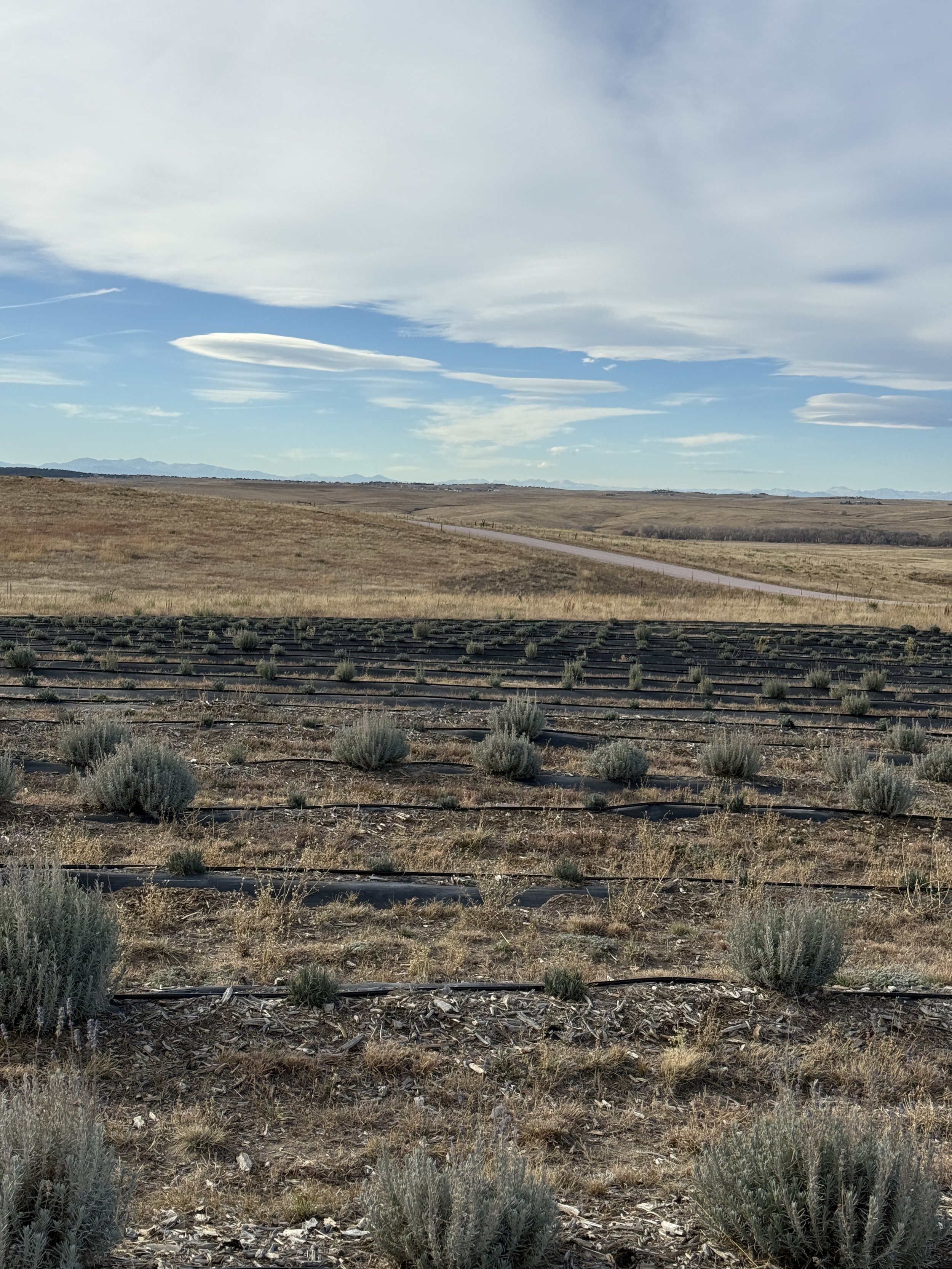
Our lavender fields begging for water.
There are so many examples of this, not just in agriculture, but across the globe as we work, hustle, and never stop in an effort to reach our goals. We believe that hustle is the road to healing, to progress and productivity. Working women, moms, WORKING MOMS, and all of us alike are striving for productive households while also reaching for goals in what little time we can squeeze in. So, when is the break? Do we ever take a break? Do we deserve a break? Maybe you're like me and put yourself in this box that locks us in saying, “you asked for this, you wanted these blessings. Now go work for them, to maintain them, to make them work in your already busy life.” I know that I have heard the lie in my head that I deserve this exhaustion. That these blessings are something I constantly have to owe and exhaust over maintaining. While it is true that the blessings that are given to us, are often worked for and will need constant attention, their purpose is to give us joy, peace, and bring us closer to God. Do you feel closer to God when you're so tired you are triggered into a tantrum because you're too overwhelmed? Do you feel closer to God when you're so numb you don't even want to get out of bed to tend to the blessings you've been given?
Well friend, as much as God has given us purpose on this earth, to experience its joy and ask for its blessings, he also asks us to reach for him, to lean closer to him. I think that’s in the rest. In fact, he commands it. So today, my bible study is diving into why I feel such a pull for rest. As it turns out, my farm has been an example for me every year.
God weaved rest into the very design of creation. From the beginning, God Himself modeled this rhythm: “By the seventh day God had finished the work He had been doing; so on the seventh day He rested” (Genesis 2:2). Not because He was tired, but to show us that rest is holy, necessary, and built into the pattern of a healthy life. Later, God makes this explicit in Exodus 20:8, commanding His people to “remember the Sabbath day and keep it holy,” reminding us that rest isn’t weakness—it’s obedience. When we choose to step back, breathe, and trust, we’re aligning ourselves with the same divine rhythm that the garden follows all winter long.
Stepping back, to breathe and see the bigger picture is sometimes EXACTLY what we need. We need to rest, and look up from time to time to align ourselves with the horizon. To verify that we haven't steered off our path and are heading a couple degrees away from our goal that will inevitably lead us no where we want to be. Sometimes our bodies need the rest, so we can listen to its needs, and maybe it’s silent pleas for help. Rest is so much more than hibernating under the covers all winter, or sitting on the couch all Sunday. Rest is rejuvenation. Rest is healing, rebuilding, realigning, reevaluating.
Our gardens do this too. It's so like God, to put the examples of his character in all the things around us. It’s hilariously obvious when you examine His creations around us that we need rest. All things rest.
In fact gardens depend on rest. After months of producing, the soil becomes depleted and needs time to rebuild its nutrients. Beneath the soil surface, God designed natural processes to continue working: microbes breaking down organic matter, moisture redistributing, and the foundation of next year’s growth slowly returning. Perennials, too, enter a sacred dormancy. While their stems appear lifeless above ground, they are storing energy deep within their roots, strengthening themselves for the abundance to come.
Winter is not wasted time—it is wisdom built into creation by God Himself. So I found in Psalm 24:1 reminds us, “The earth is the Lord’s and everything in it,” and His creation follows the rhythms He established. How cool is that? Just like with my growing season, God has provided the recipe, it’s my job to be quiet and LISTEN. Oh and, Psalm 65:9–13 paints the picture of a God who tends the land through every season, showing us that rest is not an interruption to growth—it is the preparation for it.
Rest as preparation. I’m going to let that sink in for a second….
Because when my plants come back in the spring, they don’t just come back the same as last season. They come back bigger, better, and more lush. We have a saying in flower farming: “Sleep, Creep, Leap”. A motto referring to a perennial or tree in its first three years. It will first sleep its first year, then creep its second, and then take off on that third and following years. With this concept we understand and give PERMISSION for these plants to rest that first year and get a feel for its new surroundings. We then allow them to stretch a little and explore their soil the second year. Then the third year, because we have allowed them their time to rest and recuperate, they leap out of their shyness and strive for their potential as the wonderful creations God intended them to be. We as gardeners understand this concept for plants, but can’t grant us this grace for ourselves.
It’s not just us, and it's not just in this day and age. Throughout the Bible, God uses rest to prepare His people for purpose. When Elijah was exhausted, depressed, and overwhelmed, God didn’t begin with instructions—He began with sleep, food, and quiet (1 Kings 19:5–8). Even Jesus withdrew regularly to solitary places to pray (Luke 5:16), showing us that retreat fuels our mission. Ultimately, rest is an act of trust and surrender. When we pause, we acknowledge that God is the one sustaining the world, not us. It mirrors the way a garden goes dormant—work is still happening beneath the surface even when everything looks still and almost dead. Do not forget, Psalm 46:10 invites us to “be still and know” that He is God, and Jesus Himself calls the weary to come find rest in Him (Matthew 11:28–30).
While I am still waiting for an actual frostmas over here, I have looked out on my farm and noticed it is, indeed, asleep. Even though the days are still warm, the shorter days have still told my crops to rest. While I still need to water, I know that most of the work above the surface is done. It’s up to creation to do what it was made to do, in the areas I cannot see. So it's time for me too.
How can we dive deeper into this bible study?
In our everyday lives, we can practice the same rest that God wove into our gardens, by building intentional rhythms of stillness and nourishment. Just as a garden has seasons of work and seasons of quiet, we can create daily pauses through prayer, Scripture, and journaling, small moments that allow our hearts to breathe. Weekly Sabbath becomes another layer of this rhythm, not as a rigid rule but as a gift: a day to worship, go for a slow walk, enjoy nature, or simply do something that restores your soul. And just as fields and perennials rest seasonally, we too need longer stretches of intentional slowing, our own wintering periods, and when we step back from constant productivity to allow God to replenish us. On the farm, these quiet months become fertile ground for reflection, planning, and renewed strength.
In this kind of rest, we discover that we cannot produce meaningful work, creativity, or ministry without first allowing our souls to be refilled. Like soil that must be replenished, we need God to pour into us so our roots grow deep and steady.
Take the time to jot down these bible references in your journal and take your own pause to read them for yourself. Lean in, rest, and happy gardening.

The Aurora Borealis gave us a real show this week.
Grow & Garden, Friends.
-Jessica
w/ Shari’s